Scaling a business on Meesho requires a structured approach. The Meesho seller growth guide 2026 outlines exactly how to transition from getting your first few sales to managing a massive dispatch operation of 500 orders a day. Many sellers fail because they apply large-scale strategies when they are too small, or they stick to manual processes when they have grown too large. eCommerce in India is a game of logistics, margin management, and visibility. If you understand how the platform algorithms work and how to organize your physical workspace, you can build a highly profitable business.
This guide breaks the growth journey into three distinct stages. The problems you face at 10 orders a day are completely different from the problems you face at 300 orders a day. By anticipating the operational bottlenecks at each level, you can invest in the right tools and setup at exactly the right time, maximizing your cash flow and protecting your seller metrics.
Stage 1 (0-30 orders): product selection, catalog setup, initial listing tips
In the beginning, your only goal is visibility and finding winning products. You do not need complex software or a large warehouse.
Focus entirely on your catalog quality. The Meesho algorithm rewards listings with clear, bright primary images. Use high-contrast backgrounds to make your product pop on mobile screens, as 95 percent of Meesho buyers shop on their phones. Your titles must include the most common search terms. Instead of naming a product "Elegant Floral Top", name it "Women Floral Printed Rayon Kurti Top Casual Wear". Use the maximum number of allowed keywords in the description.
Pricing strategy is critical here. Start with the lowest possible margin to generate initial sales and reviews. Once a product gets 5 to 10 positive ratings, the algorithm will push it organically, and you can slowly increase the price by 5 to 10 rupees per week to build profitability.
Stage 2 (30-100 orders): warehouse setup, thermal printer, packing station
When you cross 30 orders daily, manual packing becomes a bottleneck. You spend hours cutting A4 paper and taping labels. This is the stage where you must upgrade your physical operations.
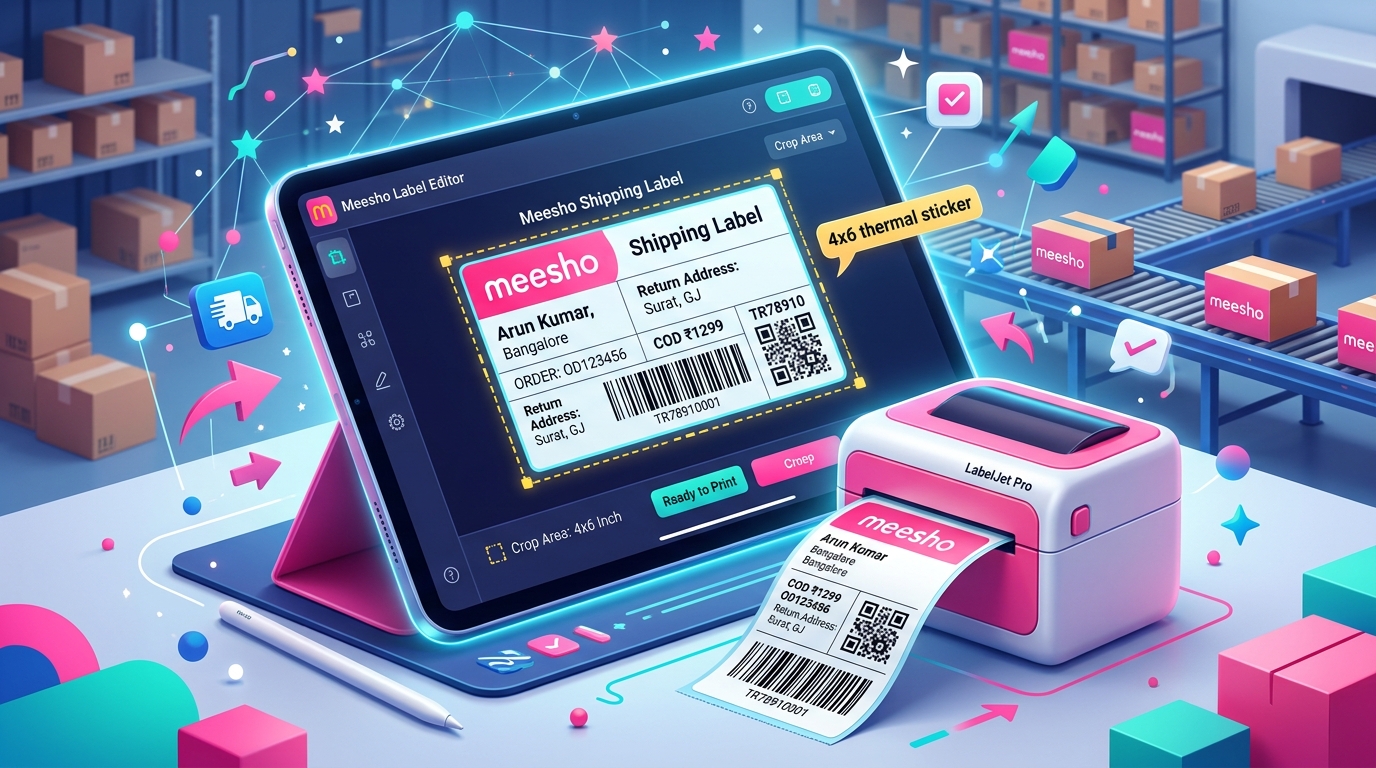
You need to invest in a 4x6 thermal printer. Brands like TVS or standard generic models cost between 4,000 and 6,000 rupees and will pay for themselves in paper and tape savings within two months. Set up a dedicated packing station. This should be a sturdy table with a tape dispenser, a stack of polybags in various sizes, and your thermal printer connected to a laptop.
Organize your inventory physically. Stop keeping products in random boxes. Assign specific racks or shelves to specific SKU codes. When an order comes in, you should know exactly which shelf to walk to. This reduces packing errors and prevents you from shipping the wrong color or size.
Stage 3 (100-500 orders): SKU batch picking, courier sorting, P&L audit
At 100 to 500 orders, efficiency dictates your profit. You cannot process orders one by one. You must shift to batch processing.
Implement SKU batch picking. Instead of reading an order, walking to the shelf, picking the item, and packing it, you group similar orders. If you have 40 orders for a specific black t-shirt, you go to the shelf once, pull 40 t-shirts, bring them to the packing table, and pack them all simultaneously. This reduces walking time by 80 percent.
Courier handover also becomes complex at this volume. Handing 500 mixed packages to four different courier boys takes hours. You must sort the packages by courier (Delhivery, XpressBees, etc.) as you pack them, placing them into separate large bags for immediate handover.
Financial auditing is non-negotiable at this scale. You must track your Profit and Loss (P&L) weekly. High volume often hides unprofitable SKUs. You need to download your payment reports and verify that the platform deductions match your expectations.
How to use TheLabelCutter tools at each stage
- Stage 1: Use the A4 4-in-1 crop feature to save paper on your standard home printer while you test the market.
- Stage 2: Switch to the 4x6 Thermal crop feature for fast, professional labeling. Use the Profit Calculator to ensure your aggressive pricing is not losing you money.
- Stage 3: Utilize the SKU Sort feature to enable batch picking. Use the Courier Sort feature to print labels grouped by delivery partner, making sorting at the packing table automatic. Use the Merge tool to handle massive multi-batch PDF downloads.
Catalog optimization: title keywords, image tips, competitive pricing
Your catalog quality determines how many organic impressions you receive on the Meesho app. Meesho shows products based on relevance to the customer search term and the product conversion rate. A listing that converts 3 percent of visitors into buyers will rank higher than a listing converting only 1 percent, regardless of price.
Use high-resolution square images (at least 1000x1000 pixels). The first image must show the product clearly against a pure white background. Avoid cluttered backgrounds or heavy watermarks that distract from the product. Include lifestyle images in subsequent slots showing the product being used or worn. These secondary images improve conversion rates significantly.
Managing RTO rate: COD verification, address filtering
Return to Origin (RTO) destroys profits because you pay forward and return shipping charges for a failed delivery. High RTO is common on Meesho due to the high volume of Cash on Delivery (COD) orders.
Monitor your orders dashboard for incomplete addresses. If a buyer provides only a village name and no street detail, the courier will likely fail to deliver. Always dispatch orders within 24 hours. The faster the package reaches the customer, the less likely they are to change their mind and reject the COD parcel.
Use the address filter functionality in TheLabelCutter to identify orders heading to high-risk geographic areas before you pack them. You can then decide to verify these orders separately before committing packing materials and shipping costs.
Payment cycle understanding: when money hits bank, TCS TDS recovery
Cash flow management keeps you alive. Meesho operates on a specific payment cycle, usually remitting funds 7 to 15 days after successful delivery. You must maintain enough working capital to purchase new inventory while waiting for these payouts.
Understand the tax deductions. The platform deducts TCS (Tax Collected at Source) and TDS (Tax Deducted at Source) automatically under GST regulations. This money is not lost. It is deposited against your PAN and GST number. You must work with your accountant to claim this money back or adjust it against your monthly GST liability when filing your GSTR-3B. Tracking these deductions accurately in a spreadsheet ensures you do not miscalculate your actual profit margin.
When to start running Meesho ads and how to budget
Do not run ads on day one. Paid advertising amplifies what is already working. If a product does not sell organically, ads will only waste your money.
Start running ads only when a product has at least a 3.8-star rating and a few reviews. Begin with a small daily budget of 300 to 500 rupees. Use the CPC (Cost Per Click) campaigns to target specific search terms. Monitor the ROI closely. If the ad spend eats up your entire profit margin, pause the campaign and work on improving the primary image or lowering the price to boost organic conversion rates.
Frequently asked questions
How much capital do I need to start on Meesho?
You can start with as little as 10,000 rupees if you source products locally. Use this to buy initial inventory and basic packaging. Reinvest all profits back into inventory for the first six months.
Should I list thousands of products or focus on a few?
Focus on a few high-quality listings. Ten optimized listings with good stock depth will perform much better than a hundred generic listings that run out of stock quickly.
What is a good profit margin to target?
Aim for a minimum of 20 to 25 percent net margin after all platform fees, shipping costs, and packaging materials are deducted. Anything less leaves you vulnerable to losses from RTOs.
How do I handle negative reviews?
You cannot remove negative reviews. The only solution is to drown them out with positive ones. Improve your product quality, ensure the packaging is secure, and the positive reviews will naturally push the overall rating up.
Do I need GST to sell on Meesho?
Yes, a valid GSTIN is mandatory to register as a seller on Meesho and all other major Indian eCommerce platforms.